
- see contact page
- Currently offline
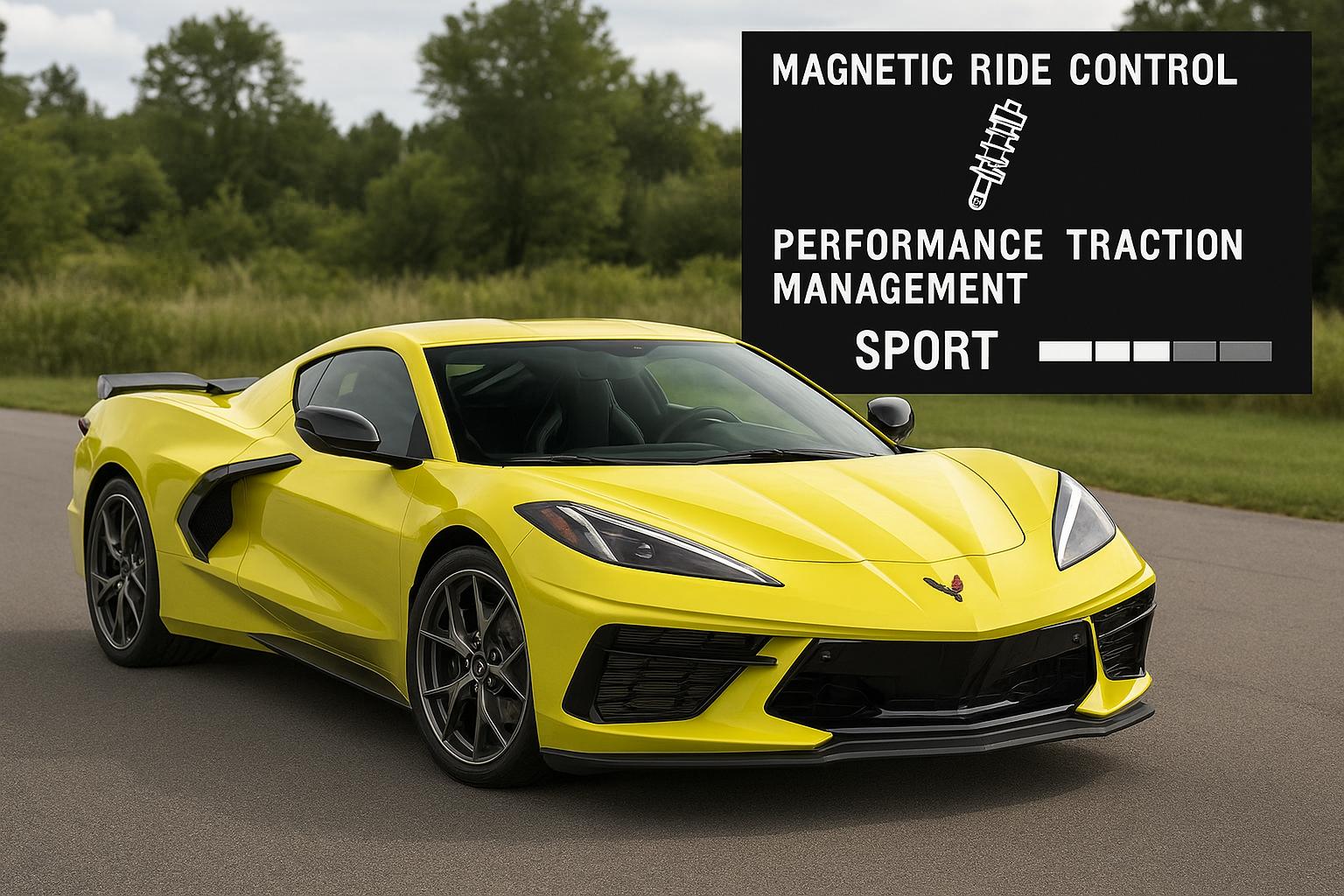
The Corvette’s performance features, such as Magnetic Ride Control.
Corvette’s Performance Features
The Chevrolet Corvette has developed a reputation over decades as a sports car that balances raw power with precise engineering. Its design philosophy has consistently focused on delivering strong acceleration, responsive handling, and stability across a wide range of driving conditions. While engine output and exterior styling often receive the most attention, the underlying performance technologies are what define the Corvette’s driving character. Among these technologies, Magnetic Ride Control plays a central role in shaping how the vehicle behaves on both road and track.
Understanding Magnetic Ride Control
Magnetic Ride Control (MRC) is a suspension system designed to adjust damping forces continuously and in real time. Unlike traditional suspension systems that rely on fixed mechanical settings or slower electronic adjustments, MRC operates using a fluid whose physical properties can be altered almost instantly. This enables the Corvette to respond quickly to changing driving conditions, whether encountering uneven pavement, entering a curve at speed, or transitioning between acceleration and braking.
The key component of this system is magneto-rheological fluid. This fluid contains microscopic iron particles suspended in oil. Under normal conditions, the fluid flows freely, allowing for a softer suspension response. When exposed to a magnetic field, however, the particles align and increase the fluid’s resistance to flow. This change in viscosity happens in milliseconds, making the system highly responsive compared to conventional adaptive suspensions.
How It Works
The operation of Magnetic Ride Control depends on a network of sensors and a central control module. Sensors positioned throughout the vehicle measure variables such as wheel position, steering input, acceleration, braking force, and road surface conditions. These inputs are processed continuously, allowing the system to determine the ideal damping force for each wheel.
Inside each shock absorber, an electromagnetic coil generates a magnetic field. By adjusting the strength of this field, the system changes the viscosity of the magneto-rheological fluid. When the field is stronger, the fluid becomes thicker, resulting in a firmer suspension. When the field is reduced, the fluid becomes less resistant, allowing for a softer ride.
This process occurs many times per second, enabling the Corvette to maintain optimal tire contact with the road. The system does not rely on pre-set modes alone, although selectable drive modes can influence its baseline behavior. Instead, it continuously refines suspension performance based on real-time feedback, which contributes to improved stability and control.
Benefits of Magnetic Ride Control
Magnetic Ride Control contributes to several aspects of the Corvette’s performance. One of the most important outcomes is improved handling. By keeping the tires in better contact with the road surface, the system enhances grip during cornering and reduces body roll. This is particularly noticeable during high-speed driving, where precise control becomes critical.
Comfort is another significant benefit. Sports cars are often associated with stiff suspensions that can transmit road imperfections directly to the cabin. MRC mitigates this by softening the suspension when appropriate, allowing the vehicle to absorb bumps more effectively. As a result, the Corvette can function as a practical daily driver without sacrificing its performance capabilities.
Adaptability also defines the system’s value. The ability to shift seamlessly between different driving conditions means the Corvette can perform well on highways, city streets, and racetracks. Drivers are not required to compromise between comfort and performance, as the system continuously balances both aspects.
Chassis and Structural Engineering
Beyond the suspension system, the Corvette’s chassis design plays an essential role in overall performance. Modern Corvette models use lightweight materials such as aluminum and composite structures to reduce mass while maintaining structural rigidity. A stiffer chassis improves the effectiveness of the suspension system, allowing Magnetic Ride Control to operate with greater precision.
Weight distribution is another important factor. With a mid-engine layout in newer generations, the Corvette achieves improved balance between the front and rear axles. This configuration enhances cornering stability and reduces the likelihood of understeer or oversteer during aggressive driving. The integration of chassis design and suspension technology creates a cohesive system that supports both control and speed.
Braking Systems and Control
Effective braking is critical for any high-performance vehicle. The Corvette is equipped with advanced braking systems designed to provide consistent stopping power under demanding conditions. Large ventilated disc brakes and multi-piston calipers help dissipate heat, reducing the risk of brake fade during repeated use.
Electronic systems such as anti-lock braking (ABS) and electronic stability control complement the mechanical components. These systems monitor wheel behavior and adjust braking force to prevent loss of traction. When combined with Magnetic Ride Control, the braking system contributes to a stable and predictable driving experience, even during rapid deceleration.
Aerodynamics and Stability
Aerodynamic design influences both speed and handling. The Corvette’s exterior shape is engineered to reduce drag while generating downforce. Reduced drag improves acceleration and fuel efficiency, while downforce increases tire grip at higher speeds.
Design elements such as front splitters, rear spoilers, and air intakes are integrated into the body to manage airflow effectively. These features work together to maintain stability, particularly when driving at highway or track speeds. Aerodynamics also interact with the suspension system, as increased downforce affects how the vehicle responds to the road surface.
Engine Performance and Power Delivery
At the core of the Corvette’s performance is its engine lineup, typically centered around naturally aspirated or supercharged V8 engines. These engines deliver substantial horsepower and torque, allowing for rapid acceleration and strong mid-range performance. The engine’s placement in newer models further enhances traction by positioning more weight over the driven wheels.
Power delivery is managed through advanced transmission systems, including dual-clutch automatic gearboxes that provide quick and smooth shifts. This ensures that power is transferred efficiently to the wheels, supporting both performance and drivability. The combination of engine output and responsive transmission contributes to the Corvette’s ability to perform consistently in various conditions.
Integrated Performance Approach
What distinguishes the Corvette is not a single feature but the integration of multiple systems working together. Magnetic Ride Control interacts with the chassis, brakes, aerodynamics, and powertrain to create a unified driving experience. Each component supports the others, resulting in a car that can adapt to different environments without requiring significant manual adjustment.
This integrated approach allows the Corvette to maintain its identity as both a high-performance sports car and a vehicle suitable for everyday use. The continuous evolution of technologies like Magnetic Ride Control reflects an ongoing effort to refine this balance, ensuring that performance improvements do not come at the expense of usability.
In summary, the Corvette’s performance features extend beyond raw power. Systems such as Magnetic Ride Control demonstrate how advanced engineering can enhance both handling and comfort. Combined with thoughtful chassis design, effective braking, aerodynamic efficiency, and strong engine performance, these features define the Corvette as a technically sophisticated and adaptable sports car.
2nd Generation

- 1963 Corvette Stingray
- 1964 Corvette Sting Ray
- 1965 Corvette Sting Ray
- 1966 Corvette Sting Ray
- 1967 Corvette Sting Ray
3rd Generation
- 1968 Corvette Sting Ray
- 1969 Corvette Sting Ray
- 1970 Corvette Sting Ray
- 1971 Corvette Sting Ray
- 1972 Corvette Sting Ray
- 1973 Corvette Sting Ray
- 1974 Corvette Sting Ray
- 1975 Corvette Sting Ray
- 1976 Corvette Sting Ray
- 1977 Corvette Sting Ray
- 1978 Corvette Sting Ray
- 1979 Corvette Sting Ray
- 1980 Corvette Sting Ray
Modern Corvettes