- see contact page
- Currently offline
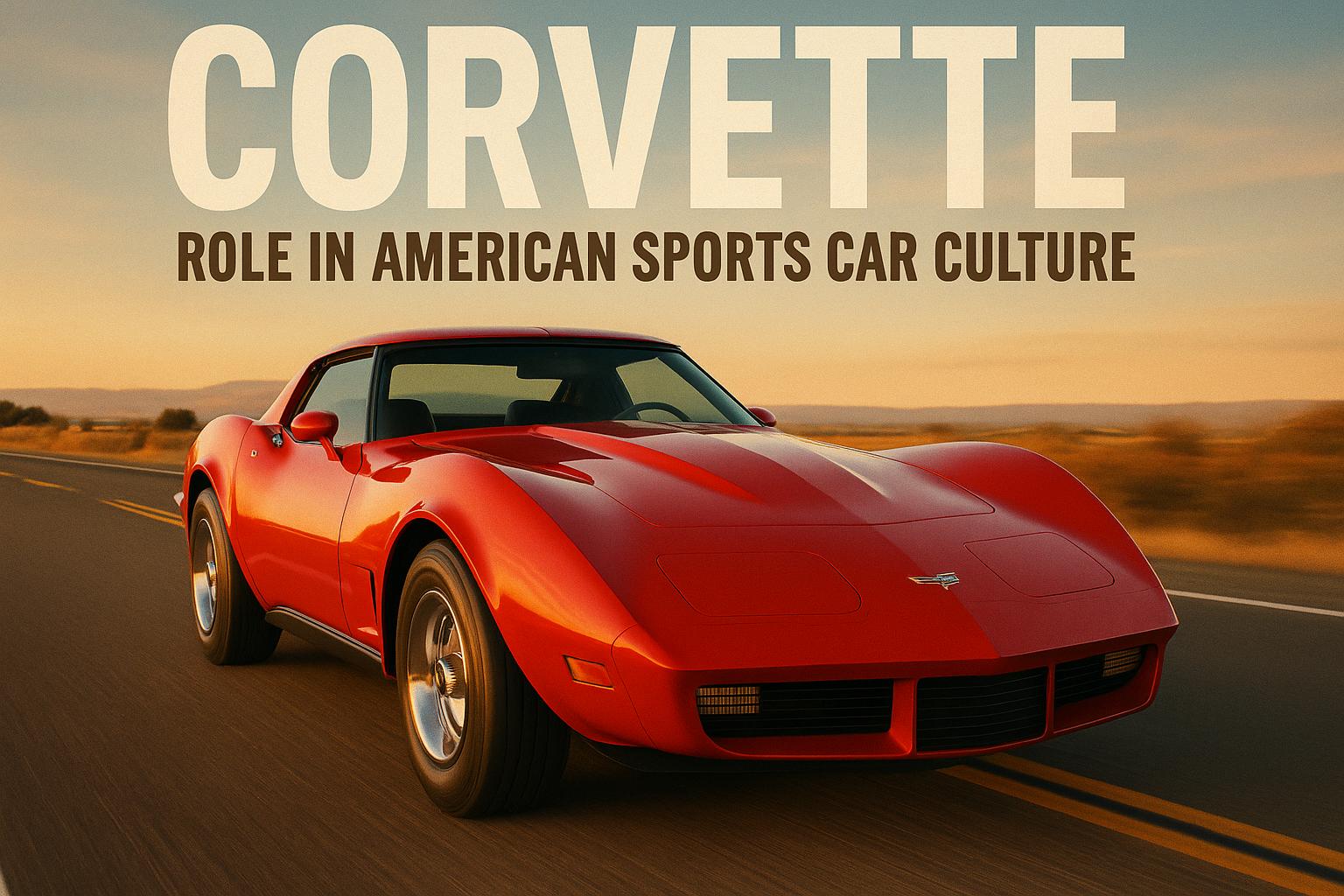
Corvette’s role in American sports car culture.
The Emergence of the Corvette
The Chevrolet Corvette has long been recognized as a defining product of American automotive engineering, representing a sustained effort to merge performance, design, and accessibility within a single platform. Introduced in 1953, the Corvette emerged during a period when American manufacturers faced increasing competition from lightweight, agile European sports cars. General Motors responded to this shift by developing a vehicle that would embody both American performance capacity and European-inspired styling, resulting in a car that spoke to evolving consumer preferences while retaining a distinctly domestic identity.
The earliest Corvette models were modest in performance compared to later iterations, yet they established critical foundations. Hand-built and limited in production, the 1953 Corvette featured a fiberglass body—an unconventional choice at the time—which reduced weight and allowed more flexibility in shaping the vehicle’s contours. Although its six-cylinder engine limited its competitiveness, the car’s aesthetic and conceptual direction positioned it as a platform with substantial long-term potential.
Design and Innovation
Design has remained central to the Corvette’s identity, with each generation reflecting both technological capability and prevailing stylistic trends. The decision to use fiberglass in early models was particularly significant, as it differentiated the Corvette from steel-bodied competitors and allowed designers to experiment more freely with aerodynamic forms. Over time, this willingness to adopt new materials and construction techniques contributed to the Corvette’s reputation as a design-forward vehicle.
As the decades progressed, the Corvette underwent multiple redesigns, each marking a shift in automotive priorities. The 1963 Sting Ray introduced a more aggressive and performance-oriented silhouette, including features such as hidden headlights and a split rear window in its coupe variant. Later generations incorporated more refined aerodynamics, with smoother lines and reduced drag coefficients, reflecting a growing emphasis on efficiency and high-speed stability.
The evolution of interior design also mirrored broader changes in the automotive industry. Early models were relatively minimalistic, focusing primarily on the driving experience. In contrast, later Corvettes incorporated advanced instrumentation, digital displays, and ergonomic enhancements, aligning the vehicle with modern expectations of comfort and usability. Innovations in materials, such as lightweight composites and carbon fiber, further demonstrated the Corvette’s ongoing adaptation to contemporary engineering standards.
Performance and Engineering
Performance has consistently been a defining attribute of the Corvette, supported by continuous advancements in engine technology and mechanical systems. A pivotal moment occurred in 1955 with the introduction of the small-block V8 engine, which significantly improved acceleration and overall power output. This development transformed the Corvette from a stylistic experiment into a legitimate high-performance contender.
Subsequent decades saw the refinement of this performance-oriented approach. Engineers improved suspension systems to enhance handling and stability, particularly at higher speeds. Independent rear suspension, introduced in the 1960s, contributed to better road contact and cornering ability, aligning the Corvette more closely with European sports car standards.
Braking systems also evolved, with the adoption of disc brakes improving stopping power and reliability. Later models incorporated advanced features such as anti-lock braking systems and electronic stability control, integrating modern safety technologies without compromising the vehicle’s performance characteristics. The balance between raw power and precise control became a central engineering goal.
In more recent generations, the Corvette has embraced advanced powertrain configurations, including supercharged engines and, eventually, a transition to a mid-engine layout. This shift marked a significant departure from the traditional front-engine design, enabling improved weight distribution and handling dynamics. The result is a vehicle that maintains its historical emphasis on power while adapting to contemporary performance engineering principles.
Cultural Impact
Beyond its technical achievements, the Corvette has held a persistent place in American cultural expression. It has frequently appeared in film, television, and music, often serving as a visual shorthand for themes such as independence, mobility, and technological optimism. Its presence in popular media has contributed to a broader recognition that extends beyond automotive enthusiasts.
During the mid-to-late twentieth century, the Corvette became associated with a particular vision of American prosperity and leisure. Ownership was often linked to personal success and discretionary income, reinforcing its image as both a performance machine and a lifestyle symbol. This dual identity helped sustain its appeal across different generations of buyers.
The Corvette also influenced automotive design trends more broadly. Competing manufacturers, both domestic and international, responded to its evolution by refining their own sports car offerings. In this sense, the Corvette functioned not only as a product but also as a reference point within the global automotive market.
At the same time, the vehicle’s cultural significance has remained adaptable. While earlier associations emphasized traditional notions of power and freedom, more recent narratives highlight technological innovation and engineering achievement. This flexibility has allowed the Corvette to remain relevant even as cultural values and consumer expectations have changed.
Role in Motorsports
The Corvette’s involvement in motorsports has played a critical role in validating its performance credentials. Although initially conceived as a production vehicle, it quickly found a place in competitive racing environments, where durability, speed, and engineering precision are tested under demanding conditions.
One of the most notable areas of success has been in endurance racing, including events such as the 24 Hours of Le Mans. Corvette racing teams have achieved multiple class victories, demonstrating the car’s ability to sustain high performance over extended periods. These achievements are not merely symbolic; they contribute directly to the refinement of production models through the transfer of technology and engineering insights.
Motorsports participation also reinforces the Corvette’s brand identity. The association with racing success enhances its credibility as a high-performance vehicle, distinguishing it from competitors that may emphasize style or comfort over track capability. Continuous involvement in racing ensures that the Corvette remains connected to a tradition of mechanical innovation and competitive excellence.
In addition, the Corvette’s racing programs have fostered a dedicated community of enthusiasts and professionals. Engineers, drivers, and fans contribute to an ecosystem in which knowledge and passion for performance are actively shared. This ecosystem supports the ongoing development of the vehicle, ensuring that it evolves in response to both technological advancements and user expectations.
In conclusion, the Corvette represents a sustained effort to integrate design, engineering, and cultural influence within a single automotive lineage. Its development from a modest postwar experiment into a globally recognized performance vehicle reflects broader trends in technology and consumer demand. Through continuous innovation and adaptation, the Corvette has maintained its relevance while preserving the core attributes that define its identity.
2nd Generation
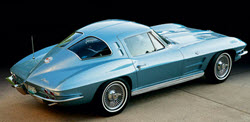
- 1963 Corvette Stingray
- 1964 Corvette Sting Ray
- 1965 Corvette Sting Ray
- 1966 Corvette Sting Ray
- 1967 Corvette Sting Ray
3rd Generation
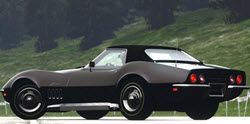
- 1968 Corvette Sting Ray
- 1969 Corvette Sting Ray
- 1970 Corvette Sting Ray
- 1971 Corvette Sting Ray
- 1972 Corvette Sting Ray
- 1973 Corvette Sting Ray
- 1974 Corvette Sting Ray
- 1975 Corvette Sting Ray
- 1976 Corvette Sting Ray
- 1977 Corvette Sting Ray
- 1978 Corvette Sting Ray
- 1979 Corvette Sting Ray
- 1980 Corvette Sting Ray
Modern Corvettes