
- see contact page
- Currently offline

How Corvettes perform on the track vs. the road.
Introduction to Corvette Performance
The Chevrolet Corvette has developed a long-standing identity as a performance-focused sports car that bridges the gap between track capability and road usability. Across multiple generations, it has incorporated advancements in engineering, aerodynamics, and materials to maintain competitiveness with global sports car benchmarks. Evaluating Corvette performance requires consideration of how the vehicle behaves in controlled environments such as race tracks, as well as in everyday driving conditions where comfort, efficiency, and durability become more relevant.
The distinction between track and road performance is important because each environment places different demands on a vehicle. On the track, maximum output and precision dominate. On public roads, adaptability and consistency are more significant. Corvette engineering reflects an attempt to satisfy both roles without compromising its identity as a performance machine.
Performance on the Track
Track environments highlight the Corvette’s engineering priorities. Closed circuits allow the car to operate near its physical limits, revealing how effectively its components work together under sustained stress.
Speed and Acceleration: Corvette models are typically powered by high-displacement engines, often naturally aspirated or paired with forced induction in newer variants. These engines deliver strong horsepower and torque figures, enabling rapid acceleration from a standstill and strong mid-range performance when exiting corners. Acceleration is not only about raw power but also about how efficiently that power is applied to the road. Rear-wheel-drive layouts, and more recently mid-engine configurations, enhance traction and balance, contributing to competitive lap times. The transition to a mid-engine platform in recent generations has further improved weight distribution, allowing faster acceleration with improved stability.
Handling: Handling defines how well a Corvette can maintain control while navigating corners at high speed. Suspension systems are engineered to minimize body roll and maintain tire contact with the road surface. Magnetic ride control systems, available in many modern Corvettes, adjust damping in real time, allowing the car to respond quickly to changes in track conditions. Steering precision is another critical component. Corvettes are designed with responsive steering systems that provide direct feedback, allowing drivers to make fine adjustments. Combined with a low center of gravity, these characteristics result in predictable and stable cornering behavior.
Aerodynamics: Aerodynamic efficiency has become increasingly important in Corvette design. Features such as front splitters, rear spoilers, diffusers, and underbody panels contribute to managing airflow around the vehicle. At high speeds, downforce increases tire grip, improving both cornering and braking performance. At the same time, reducing drag helps maintain higher top speeds on straights. Track-focused variants often include enhanced aerodynamic packages that generate greater downforce, reflecting a clear prioritization of performance over everyday practicality.
Braking: Braking systems on Corvettes are designed to withstand repeated high-speed deceleration. Large ventilated disc brakes, often paired with multi-piston calipers, provide consistent stopping power. In higher-performance trims, carbon-ceramic brake systems may be used to reduce weight and improve heat resistance. Effective braking is critical not only for safety but also for maintaining fast lap times, as late braking into corners can significantly influence overall performance. Thermal management plays a key role here, ensuring that braking performance does not degrade over extended track sessions.
Performance on the Road
While track performance highlights maximum capability, road driving emphasizes usability under varied and less predictable conditions. Corvette engineers incorporate features that make the car manageable and comfortable in everyday scenarios without losing its performance identity.
Ride Comfort: Public roads introduce irregular surfaces, traffic conditions, and longer driving durations. Corvette suspension systems are designed to adapt to these conditions. Adjustable damping allows the car to provide a smoother ride when needed, reducing harshness from road imperfections. Cabin design also contributes to comfort, with improved seating ergonomics and noise insulation in modern models. While the Corvette remains a firm-riding sports car compared to standard vehicles, it offers a level of compliance that makes extended driving feasible.
Versatility: Driving modes enable the Corvette to shift between different performance profiles. In touring or comfort modes, throttle response, suspension stiffness, and steering effort are adjusted to create a more relaxed driving experience. In sport or track modes, these systems become more aggressive, sharpening the vehicle’s responsiveness. This adaptability allows the Corvette to function as both a daily driver and a performance-oriented machine. The integration of electronic stability systems also enhances versatility by providing varying levels of driver assistance depending on the selected mode.
Fuel Efficiency: Despite its performance focus, the Corvette has evolved to include technologies that improve fuel efficiency. Cylinder deactivation systems, for example, allow the engine to operate on fewer cylinders during low-demand conditions, reducing fuel consumption during highway cruising. Transmission advancements, including multi-speed automatic gearboxes and efficient manual transmissions, further optimize fuel usage. While fuel efficiency is not the primary concern for a sports car, these improvements make the Corvette more practical for regular use.
Reliability: Long-term reliability is essential for road use. Corvette engineering has increasingly emphasized durability, with improvements in material quality, manufacturing processes, and component design. Modern Corvettes benefit from rigorous testing to ensure consistent performance over time. Maintenance considerations also influence the ownership experience, as high-performance components must balance longevity with capability. While maintenance requirements may be higher than those of standard vehicles, the Corvette is designed to provide dependable operation when properly maintained.
Balancing Track and Road Demands
The ability of the Corvette to perform well in both environments reflects a broader engineering challenge: balancing extremes. Track conditions demand uncompromising performance, while road use requires adaptability and comfort. Corvette design integrates technologies that allow it to transition between these roles without requiring significant modifications.
Weight distribution, chassis rigidity, and tire selection all play roles in achieving this balance. For example, tires used for track performance prioritize grip but may wear faster and produce more noise on regular roads. Manufacturers address this by offering different tire options or designing compounds that provide a compromise between durability and performance. Similarly, suspension systems are tuned to offer both precision and compliance, aided by electronic adjustments.
Technological Advancements
Advancements in automotive technology have significantly influenced Corvette performance. Electronic driver aids, data monitoring systems, and performance telemetry allow drivers to better understand and optimize the car’s behavior. These systems can record lap times, analyze braking and acceleration patterns, and provide feedback for improvement. On the road, similar technologies enhance safety and convenience, including driver assistance features that were less common in earlier generations.
Engine technology has also evolved, with improved efficiency, emissions control, and power delivery. Lightweight materials such as aluminum and composite panels contribute to overall performance by reducing mass without compromising structural integrity. These developments collectively ensure that the Corvette remains competitive in both track and road contexts.
Conclusion
The Chevrolet Corvette demonstrates a dual-purpose design that addresses the distinct demands of track and road driving. On the track, it emphasizes speed, handling precision, aerodynamic efficiency, and braking capability. On the road, it adapts these attributes to provide comfort, versatility, efficiency, and reliability. This combination allows the Corvette to function not only as a high-performance sports car but also as a practical vehicle for regular use. Its continued evolution reflects an ongoing effort to refine this balance while maintaining its core identity as a performance-focused automobile.
2nd Generation

- 1963 Corvette Stingray
- 1964 Corvette Sting Ray
- 1965 Corvette Sting Ray
- 1966 Corvette Sting Ray
- 1967 Corvette Sting Ray
3rd Generation
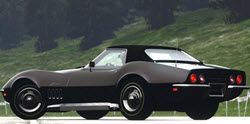
- 1968 Corvette Sting Ray
- 1969 Corvette Sting Ray
- 1970 Corvette Sting Ray
- 1971 Corvette Sting Ray
- 1972 Corvette Sting Ray
- 1973 Corvette Sting Ray
- 1974 Corvette Sting Ray
- 1975 Corvette Sting Ray
- 1976 Corvette Sting Ray
- 1977 Corvette Sting Ray
- 1978 Corvette Sting Ray
- 1979 Corvette Sting Ray
- 1980 Corvette Sting Ray
Modern Corvettes