- see contact page
- Currently offline
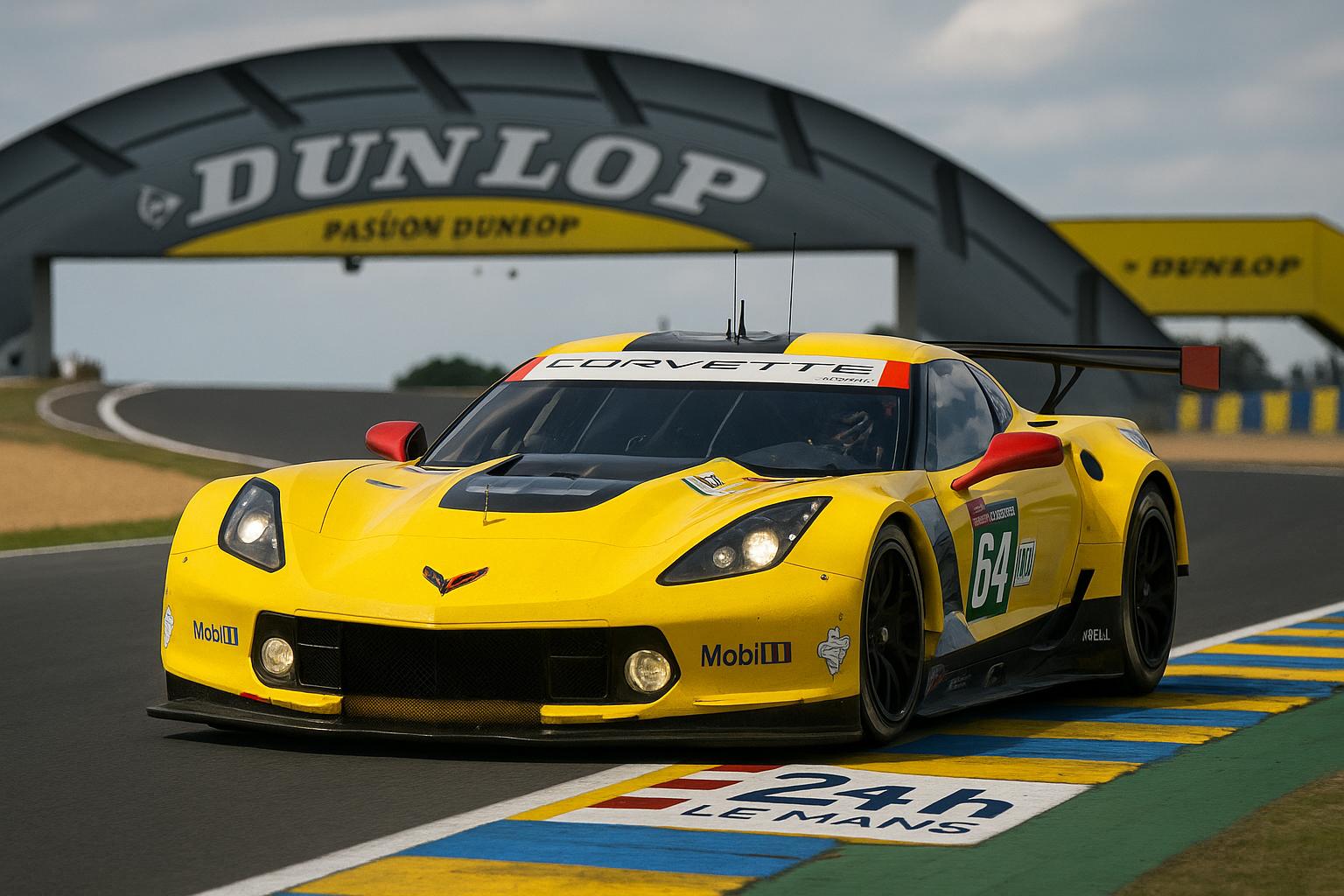
The racing heritage of the Corvette in Le Mans.
The Corvette’s Entry into Le Mans
The Chevrolet Corvette has maintained a sustained presence in international endurance racing, most notably at the 24 Hours of Le Mans. This association reflects a broader interaction between American automotive engineering and European motorsport traditions. Since its initial appearance in 1960, the Corvette has undergone continuous development, aligning its design and performance with the evolving technical and regulatory landscape of endurance racing. Its participation has served both as a competitive endeavor and as a testing ground for production-relevant technologies.
The 1960s: The Inception of Tradition
The Corvette’s first appearance at Le Mans took place in 1960 under the direction of Briggs Cunningham, an American racing driver and constructor with prior experience competing in European endurance racing. Cunningham entered three largely production-based Corvette C1 models, modified to meet racing requirements. These cars were relatively simple compared to European prototypes but emphasized durability and engine displacement, two characteristics that would define Corvette racing for decades.
The 1960 race presented multiple challenges. Two of the three Corvettes were forced to retire due to mechanical failures, reflecting the difficulty of adapting a production-derived vehicle to a 24-hour endurance format. However, the third car, driven by John Fitch and Bob Grossman, completed the race successfully and secured a class victory. This outcome demonstrated that, despite limitations in refinement and aerodynamic efficiency, the Corvette could compete effectively in long-distance racing under the right conditions.
Performance Highlight: 1960
The class win achieved by Fitch and Grossman was significant for several reasons. It provided a measurable benchmark for American engineering against established European manufacturers such as Ferrari, Porsche, and Aston Martin. The Corvette’s relatively large-displacement V8 engine delivered consistent power output, while its straightforward mechanical layout contributed to serviceability during the race.
This result also influenced perceptions of American sports cars in international competition. Prior to this, American entries were often viewed as less sophisticated. The Corvette’s success challenged that assumption, indicating that performance could be achieved through reliability and engineering pragmatism rather than complexity alone.
Technological Developments
Following its initial success, Corvette development shifted toward improving both competitiveness and compliance with evolving racing standards. Throughout the 1960s and 1970s, Corvette racing efforts were intermittent, but the lessons learned during this period informed later factory-supported programs.
Aerodynamics became an increasingly important focus. Early Corvette designs prioritized styling and engine output over airflow efficiency, but endurance racing required better high-speed stability and fuel efficiency. Subsequent models incorporated refined body shapes, improved cooling systems, and reduced drag coefficients.
Engine technology also advanced significantly. While early Corvettes relied on large-displacement pushrod V8 engines, later developments improved fuel delivery, combustion efficiency, and durability. These enhancements allowed the engines to sustain high output over extended periods without excessive wear, a critical requirement for endurance racing.
Materials engineering evolved as well. The introduction of lightweight composite materials reduced overall vehicle weight while maintaining structural integrity. Braking systems improved with the adoption of disc brakes and later carbon-based components, increasing reliability under continuous use. Suspension systems were refined to provide better handling characteristics, particularly on the varied surfaces and long straights of the Le Mans circuit.
Electronics emerged as an important component in the late 20th century. Data acquisition systems allowed teams to monitor performance metrics in real time, leading to more informed decisions during races. Engine management systems also contributed to improved fuel efficiency and consistency, which are essential factors in endurance racing strategy.
Modern Era: Consistent Competitor
The modern phase of Corvette participation at Le Mans began in earnest with the establishment of Corvette Racing in 1999, operated by Pratt & Miller. This marked a transition to a fully professional, factory-backed program with dedicated engineering support, specialized drivers, and long-term development strategies.
Since its inception, Corvette Racing has achieved multiple class victories at Le Mans, particularly in the GTS and later GTE categories. The team’s approach emphasizes incremental improvement, focusing on reliability, tire management, fuel strategy, and driver consistency. Unlike shorter sprint races, Le Mans rewards sustained performance over a 24-hour period, making operational discipline as important as outright speed.
The Corvette C5-R, introduced in 1999, established a strong competitive foundation with multiple wins in its class. It was succeeded by the C6.R and later the C7.R, each generation incorporating advancements in aerodynamics, materials, and powertrain technology. The transition to the mid-engine C8.R represented a major architectural shift, aligning Corvette design more closely with contemporary supercar layouts and improving weight distribution and cornering performance.
Driver lineups have also played a critical role. Corvette Racing has consistently employed experienced endurance drivers capable of maintaining pace while minimizing errors. Coordination between drivers, engineers, and pit crews has been a defining factor in the team’s sustained success.
The regulatory environment at Le Mans has continued to evolve, influencing vehicle design and performance parameters. Balance of Performance (BoP) adjustments, which aim to equalize competition across different manufacturers, have required Corvette Racing to adapt its strategies without fundamentally altering its design philosophy. This has reinforced the importance of reliability and execution rather than reliance on peak performance alone.
Beyond competition, Corvette’s participation at Le Mans has had implications for production vehicles. Technologies developed in racing environments, such as advanced cooling systems, lightweight materials, and performance-oriented suspension setups, have been adapted for road-going Corvettes. This relationship between racing and production reinforces the role of Le Mans as a testing ground for automotive innovation.
The 24 Hours of Le Mans remains one of the most demanding events in motorsport, requiring a combination of engineering precision, strategic planning, and operational consistency. The Corvette’s continued involvement demonstrates an ongoing commitment to these principles. Its history at Le Mans reflects a progression from experimental participation to sustained competitiveness within a highly technical and regulated environment.
As of today, the Corvette represents both a legacy brand and an active participant in endurance racing. Its presence at Le Mans illustrates how long-term development, combined with adaptation to technological and regulatory changes, can sustain competitiveness over multiple decades. Additional historical and technical details regarding Corvette racing efforts can be found through resources such as the Corvette Museum, which documents the marque’s involvement in motorsport and its broader automotive contributions.
2nd Generation
- 1963 Corvette Stingray
- 1964 Corvette Sting Ray
- 1965 Corvette Sting Ray
- 1966 Corvette Sting Ray
- 1967 Corvette Sting Ray
3rd Generation
- 1968 Corvette Sting Ray
- 1969 Corvette Sting Ray
- 1970 Corvette Sting Ray
- 1971 Corvette Sting Ray
- 1972 Corvette Sting Ray
- 1973 Corvette Sting Ray
- 1974 Corvette Sting Ray
- 1975 Corvette Sting Ray
- 1976 Corvette Sting Ray
- 1977 Corvette Sting Ray
- 1978 Corvette Sting Ray
- 1979 Corvette Sting Ray
- 1980 Corvette Sting Ray
Modern Corvettes