
- see contact page
- Currently offline
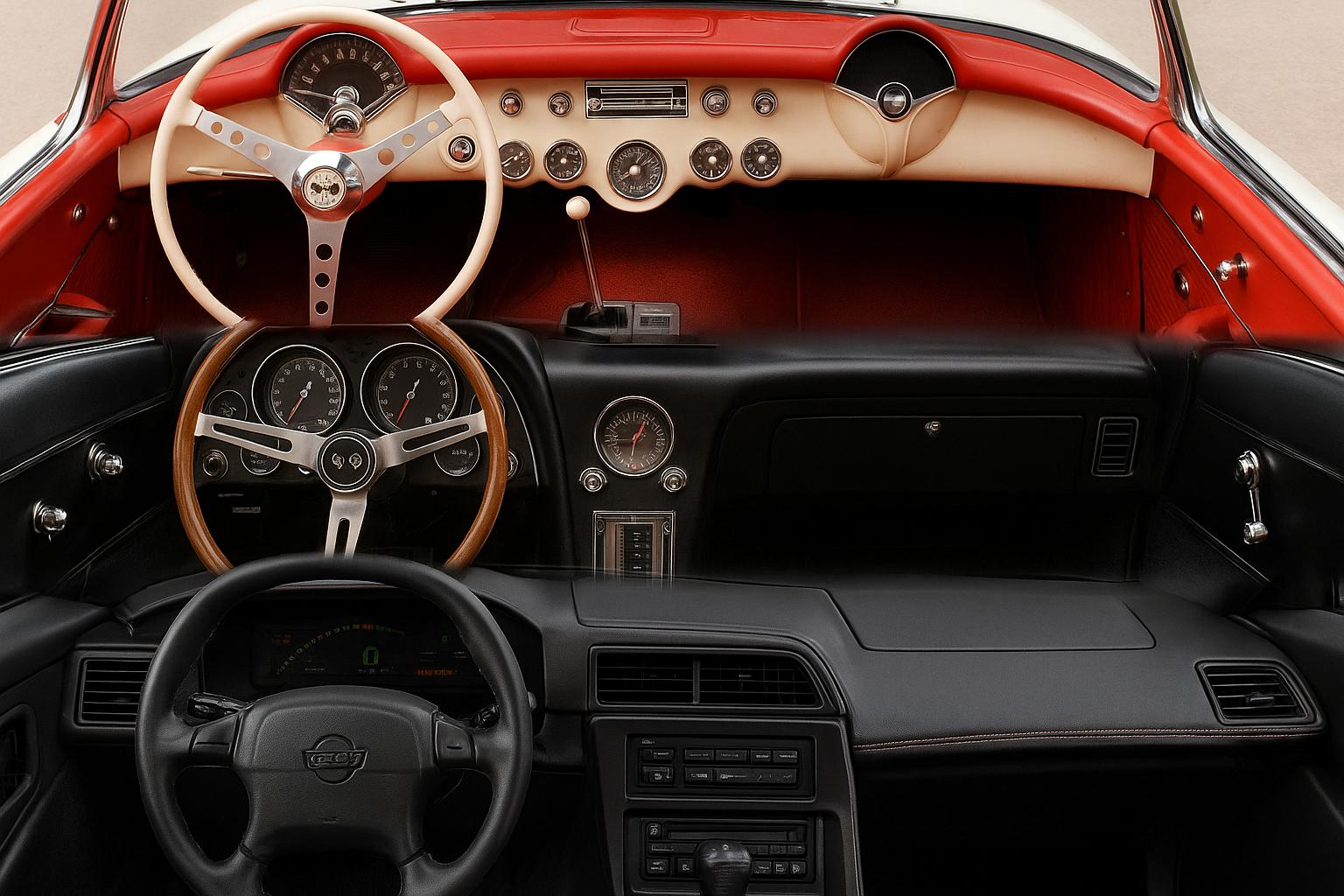
The evolution of Corvette interiors over the years.
The Early Years: 1953-1962
The interior design of the Corvette in its early years was modest, reflecting broader automotive trends in postwar America. When the first Corvette was introduced in 1953, its focus was not on interior refinement but on establishing a new identity for an American sports car. The cabin was simple and functional, with a clean dashboard layout that prioritized essential driving information. Instrumentation was limited, typically including a speedometer and a few basic gauges, while controls were operated through straightforward knobs and switches.
Materials used during this period were practical rather than premium. Vinyl upholstery was common, and interior panels were constructed with durability in mind rather than luxury. Chrome accents appeared sparingly, primarily to provide a sense of visual contrast rather than opulence. Color choices were subdued, often limited to neutral tones such as gray, beige, or black, aligning with prevailing design norms of the time.
Despite its simplicity, the early Corvette interior laid the groundwork for later developments. The emphasis on driver accessibility, even in a minimal form, established a principle that would continue to guide future designs. While comfort and sophistication were limited, the interior served its purpose effectively within the context of a lightweight, performance-oriented vehicle.
The 1960s: A Shift Towards Modernity
The 1960s marked a clear transition in Corvette interior design, driven by both technological progress and changing consumer expectations. With the introduction of the second-generation Corvette in 1963, often referred to as the C2, the interior began to reflect a more deliberate focus on the driver. The dashboard became more complex, incorporating additional gauges that provided detailed performance data such as engine temperature, oil pressure, and tachometer readings.
This era saw the introduction of bucket seats as a standard feature, significantly improving driver and passenger support during more dynamic driving. The seating design was more sculpted, offering better ergonomics compared to earlier flat bench-style configurations. Interior materials also improved, with higher-grade plastics and more extensive use of chrome trim creating a more refined appearance.
Designers began to consider both aesthetics and usability in tandem. Controls were more logically arranged, and the steering wheel design evolved to complement the increasingly sophisticated dashboard layout. The combination of improved materials and enhanced instrumentation signaled a move toward a more modern and performance-oriented interior environment.
The 1970s: Incorporating Technology
During the 1970s, Corvette interiors continued to evolve, incorporating new technological elements while adapting to stricter safety and regulatory requirements. Gauge clusters became more advanced, often featuring clearer layouts and improved readability. At the same time, federally mandated safety standards influenced interior design, leading to the introduction of energy-absorbing steering columns and more heavily padded surfaces.
Aesthetically, the decade introduced a mix of textures and materials. Wood-grain accents became a popular design feature, adding a sense of traditional luxury, while leather upholstery began to appear more frequently in higher trims. These elements were intended to elevate the interior ambiance without compromising the car’s performance-focused identity.
However, the push for safety and emissions compliance also resulted in some trade-offs. Certain design aspects were simplified, and performance-focused instrumentation occasionally gave way to more standardized layouts. Despite these constraints, the Corvette maintained a distinct interior identity, balancing evolving regulations with its established emphasis on driver engagement.
The 1980s and 1990s: Experimentation and Innovation
The 1980s and 1990s represented a period of experimentation, as automotive manufacturers explored new technologies and design philosophies. Corvette interiors reflected this trend through the introduction of digital dashboards, which replaced traditional analog gauges with electronic displays. These digital interfaces were intended to provide a futuristic driving experience, though their reception varied among drivers.
Ergonomics became a more significant consideration during this period. Interior layouts were redesigned to improve driver comfort, with controls positioned for easier reach and visibility. Seating technology also advanced, incorporating better cushioning and adjustable features that allowed for a more customized driving position.
Material choices expanded as well. While plastics remained prevalent, improvements in manufacturing techniques allowed for higher-quality finishes. Leather upholstery became more common, and interior color schemes diversified beyond the neutral tones of earlier decades. These changes reflected a broader industry trend toward creating interiors that balanced performance with everyday usability.
By the 1990s, Corvette interiors had become more cohesive and refined. The integration of analog and digital elements improved usability, and the overall design language emphasized clarity and functionality. This period laid the groundwork for the more polished and technology-driven interiors that would emerge in the following decades.
The 2000s: Emphasis on Comfort and Performance
Entering the 21st century, Corvette interior design shifted toward a more balanced approach that combined performance with comfort. Advances in manufacturing and materials allowed for a noticeable improvement in build quality, addressing criticisms of earlier interiors. Leather became a standard feature in many models, and seating designs were further refined to provide both support and long-distance comfort.
One of the most significant developments during this era was the integration of infotainment systems. Features such as GPS navigation, premium audio systems, and early forms of connectivity began to appear, reflecting the growing importance of in-car technology. These systems were gradually incorporated into the dashboard design, marking a shift away from purely mechanical interfaces toward more digitally integrated environments.
The overall cabin layout became more driver-centric, with controls angled toward the driver and improved visibility of key information displays. This approach reinforced the Corvette’s identity as a performance vehicle while acknowledging the expectations of modern drivers who sought both capability and convenience.
The 2010s to Present: Luxury and Cutting-Edge Technology
From the 2010s onward, Corvette interiors have undergone a significant transformation, emphasizing luxury and advanced technology. The introduction of the seventh generation (C7) in 2014 marked a turning point, with a clear focus on high-quality materials such as Napa leather, real aluminum trim, and soft-touch surfaces throughout the cabin. These improvements elevated the Corvette’s interior to compete with more established luxury sports cars.
Technology integration became more sophisticated, with large touchscreen displays serving as central control hubs for navigation, entertainment, and vehicle settings. Digital instrument clusters provided customizable displays, allowing drivers to tailor the information presented according to their preferences. Connectivity features, including smartphone integration, became standard, reflecting broader trends in automotive design.
The most recent generation has further refined this approach, introducing a cockpit-style layout that emphasizes immersion and driver focus. The center console is often elevated and angled, creating a distinct separation between driver and passenger areas. Controls are arranged in a structured manner, with an emphasis on accessibility and intuitive operation.
Today, Corvette interiors reflect a synthesis of tradition and innovation. While maintaining its performance-oriented roots, the design now incorporates advanced materials, precision craftsmanship, and sophisticated technology. This evolution demonstrates how the Corvette has adapted to changing expectations while preserving its identity as a distinctly American sports car.
For more details about Corvette’s design history, you might explore official manufacturer resources.
2nd Generation

- 1963 Corvette Stingray
- 1964 Corvette Sting Ray
- 1965 Corvette Sting Ray
- 1966 Corvette Sting Ray
- 1967 Corvette Sting Ray
3rd Generation
- 1968 Corvette Sting Ray
- 1969 Corvette Sting Ray
- 1970 Corvette Sting Ray
- 1971 Corvette Sting Ray
- 1972 Corvette Sting Ray
- 1973 Corvette Sting Ray
- 1974 Corvette Sting Ray
- 1975 Corvette Sting Ray
- 1976 Corvette Sting Ray
- 1977 Corvette Sting Ray
- 1978 Corvette Sting Ray
- 1979 Corvette Sting Ray
- 1980 Corvette Sting Ray
Modern Corvettes