
- see contact page
- Currently offline
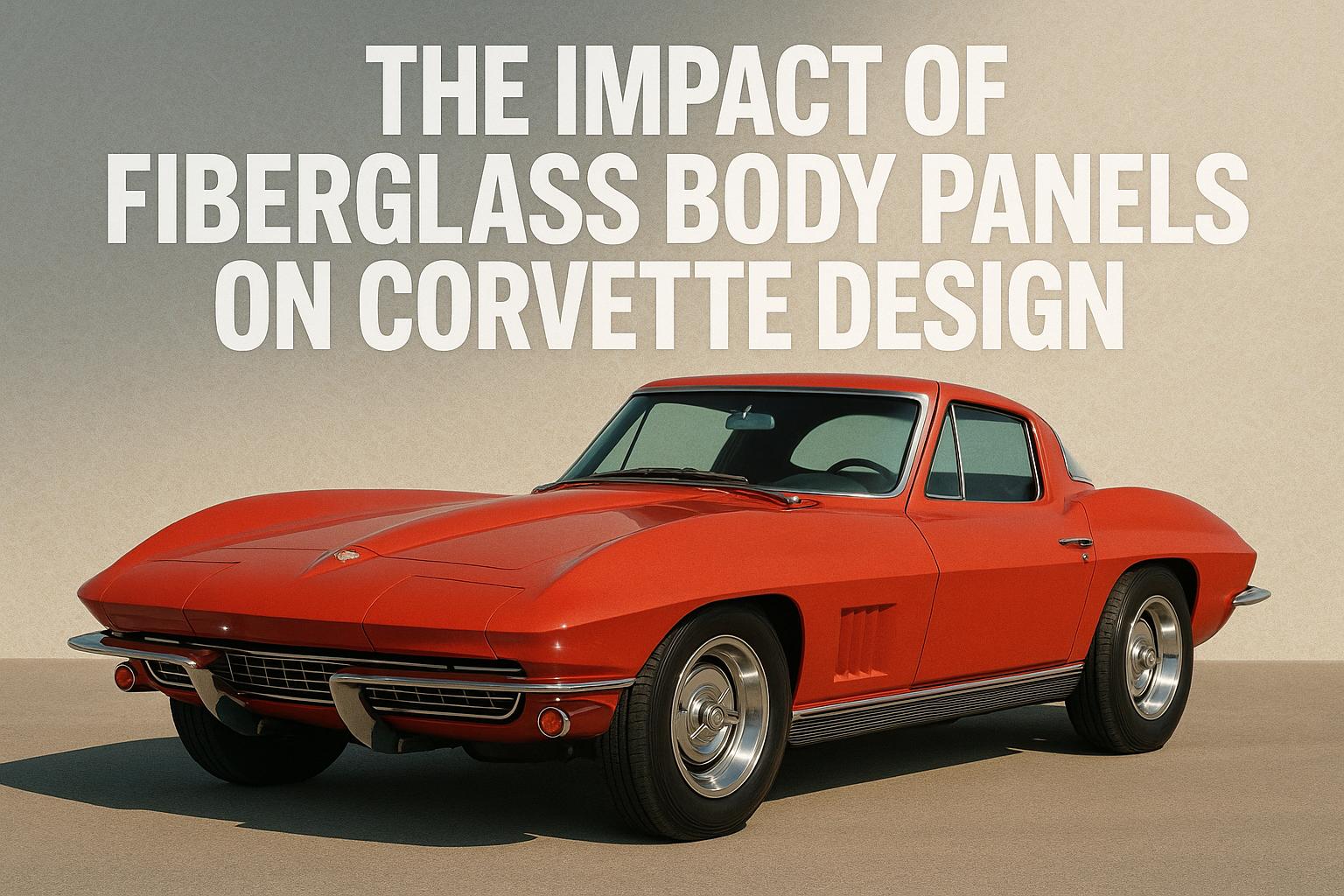
The impact of fiberglass body panels on Corvette design.
The Introduction of Fiberglass in Automotive Design
Fiberglass body panels have played a pivotal role in the evolution of the Chevrolet Corvette, significantly influencing its design, manufacturing process, and long-term identity. When the Corvette debuted in 1953 with fiberglass body construction, it represented a departure from conventional automotive practices that relied almost entirely on stamped steel. This transition did not occur in isolation; it was influenced by post-war material experimentation and a growing interest in lightweight alternatives that could support performance-oriented vehicles.
At the time, the adoption of fiberglass was as much a practical decision as it was an innovative one. Limited steel availability during the early 1950s prompted manufacturers to explore substitute materials. Fiberglass, already used in boat building and certain industrial applications, emerged as a viable candidate due to its flexibility in molding and relatively low tooling costs. For a low-volume sports car like the Corvette, fiberglass allowed General Motors to produce complex shapes without the high expense associated with steel stamping dies.
Characteristics and Advantages of Fiberglass
Fiberglass is a composite material consisting of fine glass fibers embedded within a polymer resin. This combination creates a structure that is both lightweight and strong relative to its density. One of its most important attributes in automotive design is its lightweight nature, which reduces overall vehicle mass. Lower weight contributes directly to improved acceleration, braking efficiency, and, to a lesser extent, fuel economy.
Another critical advantage is its corrosion resistance. Unlike steel, fiberglass does not rust when exposed to moisture, road salt, or environmental contaminants. This property enhances longevity and reduces long-term maintenance concerns related to body degradation. For owners, this meant that the Corvette could maintain its exterior appearance over time without the same vulnerability to corrosion found in traditional metal-bodied vehicles.
Fiberglass also offers significant design flexibility. Because it can be molded into complex shapes, engineers and designers are not constrained by the same limitations imposed by metal forming techniques. This allows for integrated body panels, smoother contours, and fewer seams. The result is a more cohesive exterior design and improved aerodynamic potential.
Impact on Corvette’s Design and Performance
The introduction of fiberglass directly influenced the Corvette’s visual and functional development. Designers were able to experiment with aerodynamic and creative shapes that would have been difficult or cost-prohibitive using steel. Early Corvette models featured flowing lines and sculpted curves that reflected both styling ambitions and aerodynamic considerations. Over time, these design freedoms contributed to the Corvette’s consistent visual identity as a performance-oriented sports car.
From a performance perspective, reduced weight played a central role. A lighter vehicle requires less power to achieve the same acceleration as a heavier counterpart. This allowed the Corvette to deliver competitive performance even with modest engine outputs in its early years. As engine technology advanced, the combination of increased power and lightweight construction further enhanced its capabilities.
Weight distribution also benefited from the use of fiberglass. Engineers could better manage how mass was distributed across the chassis, leading to improved balance and more predictable handling characteristics. A lower center of gravity, combined with reduced overall mass, contributed to better cornering stability and responsiveness. These factors collectively reinforced the Corvette’s reputation as a vehicle designed with performance as a primary objective.
Durability Challenges and Technological Innovations
Despite its advantages, fiberglass introduced several challenges, particularly in its early applications. One of the most notable limitations was its limited impact resistance. Unlike steel, which can deform under stress, fiberglass tends to crack or fracture when subjected to significant impact forces. Early Corvette models occasionally exhibited issues related to brittleness, especially in colder conditions where materials can become less flexible.
Manufacturing consistency also posed difficulties. The early hand-laid fiberglass processes could result in variations in panel thickness and surface finish. This sometimes led to fitment inconsistencies and increased labor requirements during assembly. Over time, refinements in production techniques, including improved mold design and more controlled curing processes, helped address these issues.
Technological advancements significantly improved the performance of fiberglass composites. The development of better resin systems enhanced strength, flexibility, and resistance to environmental factors such as ultraviolet radiation. Reinforcement techniques, including the strategic layering of fibers, allowed engineers to tailor material properties to specific structural requirements.
In more recent Corvette generations, traditional fiberglass has been supplemented or partially replaced by advanced composite materials. These include sheet molding compounds (SMC) and other engineered composites that offer greater strength, improved surface quality, and enhanced durability. These materials maintain many of the benefits of fiberglass while addressing its earlier shortcomings. As a result, modern Corvette body panels exhibit better impact resistance, improved dimensional stability, and higher overall quality.
Evolution of Manufacturing Techniques
The shift to fiberglass also influenced how vehicles were manufactured. Unlike steel bodies, which require large stamping presses and extensive tooling, fiberglass panels can be produced using molds that are comparatively less expensive and more adaptable. This made it feasible to introduce design changes with reduced investment, supporting iterative improvements across model years.
As production volumes increased, manufacturing processes evolved to incorporate automation and better quality control. Techniques such as compression molding enabled faster production cycles and more consistent results. These advancements allowed fiberglass and composite materials to remain viable even as production demands grew.
The integration of these materials also required new approaches to assembly. Bonding techniques, rather than traditional welding, became a central aspect of construction. Adhesives and mechanical fasteners were used to join panels to the underlying structure. This shift influenced not only production methods but also repair practices, as fiberglass requires different techniques compared to metal bodywork.
Conclusion
The introduction of fiberglass body panels was a transformative development in the history of the Chevrolet Corvette and the broader automotive industry. By enabling lightweight construction, corrosion resistance, and greater design flexibility, fiberglass helped define the Corvette’s identity as a performance-focused vehicle with distinctive styling.
Although early challenges related to durability and manufacturing complexity were present, ongoing technological advancements addressed many of these limitations. The evolution from basic fiberglass panels to advanced composite systems reflects a continuous effort to balance performance, cost, and reliability.
Today, the legacy of fiberglass in Corvette design remains evident. While modern materials have expanded upon its foundation, the original decision to adopt fiberglass established a framework for innovation that continues to influence automotive engineering.
2nd Generation

- 1963 Corvette Stingray
- 1964 Corvette Sting Ray
- 1965 Corvette Sting Ray
- 1966 Corvette Sting Ray
- 1967 Corvette Sting Ray
3rd Generation

- 1968 Corvette Sting Ray
- 1969 Corvette Sting Ray
- 1970 Corvette Sting Ray
- 1971 Corvette Sting Ray
- 1972 Corvette Sting Ray
- 1973 Corvette Sting Ray
- 1974 Corvette Sting Ray
- 1975 Corvette Sting Ray
- 1976 Corvette Sting Ray
- 1977 Corvette Sting Ray
- 1978 Corvette Sting Ray
- 1979 Corvette Sting Ray
- 1980 Corvette Sting Ray
Modern Corvettes