
Introduction
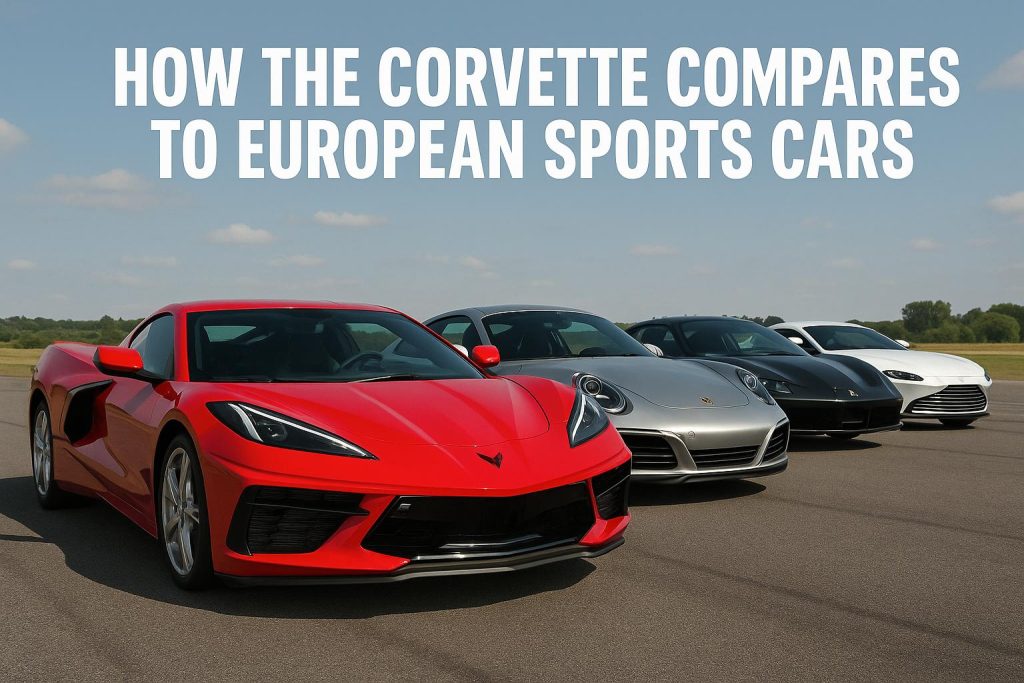
The Chevrolet Corvette has long occupied a distinctive place within the global sports car landscape. Originally conceived as an attainable alternative to European performance vehicles, it evolved into a model that blends high-output engineering with comparatively accessible pricing. Over decades of development, the Corvette has changed in response to shifting expectations in performance, design, and technology. When considered alongside European sports cars such as those produced by Porsche, Ferrari, and Aston Martin, the comparison highlights differences in engineering priorities, manufacturing philosophy, and market positioning.
While early comparisons often emphasized contrasts between American power and European refinement, these distinctions have become less rigid over time. Advances in materials, aerodynamics, and drivetrain configurations have allowed manufacturers on both sides to adopt strategies once associated primarily with the other. As a result, modern evaluations require a closer examination of multiple dimensions, including performance characteristics, ownership costs, and cultural significance.
Performance
Performance remains one of the most visible criteria when evaluating sports cars. Historically, the Corvette has been associated with large-displacement engines capable of producing high levels of horsepower and torque. This focus resulted in strong acceleration figures, particularly in straight-line scenarios. Models such as the Corvette Z06 and ZR1 reinforced this identity, offering performance metrics that rivaled or exceeded many European competitors at higher price points.
The introduction of the mid-engine Corvette C8 marked a notable shift in engineering philosophy. By relocating the engine behind the driver, Chevrolet improved weight distribution and enhanced handling stability. This configuration aligns more closely with longstanding European design practices, particularly those used by Ferrari and Lamborghini. The result is a vehicle that maintains strong acceleration while also improving balance during cornering and high-speed maneuvers.
European sports cars continue to emphasize advanced engineering solutions, including turbocharging, hybrid systems, and precision-tuned suspensions. Porsche, for instance, has established a reputation for extracting consistent performance through incremental refinement. Its 911 model, despite retaining a rear-engine layout, demonstrates how careful engineering can overcome inherent design challenges to produce a highly capable performance vehicle.
Handling and Driving Experience
Handling characteristics have traditionally represented a key area of differentiation. Earlier Corvette generations were often associated with a focus on acceleration rather than cornering precision. However, continuous improvements in suspension systems, tire technology, and chassis rigidity have narrowed this gap significantly.
Modern Corvettes incorporate adaptive suspension systems and electronic driving aids that allow the vehicle to adjust to varying conditions. These systems enhance both everyday usability and track performance. The transition to a mid-engine layout further improves responsiveness and driver confidence during high-speed cornering.
European sports cars often prioritize consistency and predictability in handling. Vehicles from manufacturers such as Porsche and Aston Martin are engineered to provide a balanced driving experience across a wide range of conditions. Steering feedback, braking control, and weight transfer are calibrated to create a cohesive interaction between driver and machine. While performance figures are important, the emphasis is frequently placed on how the car responds rather than solely on measurable outputs.
Price
Pricing remains one of the most defining contrasts between the Corvette and its European counterparts. The Corvette has consistently delivered high levels of performance at a comparatively lower cost. This value proposition has been central to its identity since its inception. Even in its more advanced configurations, the Corvette typically remains more affordable than many European models with similar specifications.
European sports cars often command higher prices due to factors such as brand positioning, limited production volumes, and the use of specialized materials. Ferrari and Aston Martin, for example, operate within a segment that emphasizes exclusivity as part of the ownership experience. This exclusivity contributes to pricing structures that place these vehicles beyond the reach of many buyers.
Cost of Ownership
Ownership costs extend beyond the purchase price and include maintenance, insurance, and depreciation. The Corvette benefits from a widespread service network, particularly in North America, where parts availability and labor costs are generally lower. This contributes to a more predictable ownership experience over time.
European sports cars can involve higher maintenance costs due to specialized components and service requirements. In some cases, routine maintenance may require certified technicians or brand-specific facilities. Insurance premiums may also reflect the higher value of these vehicles. However, certain European models maintain strong resale values, particularly those associated with established performance heritage.
Design and Styling
Design has evolved significantly for both American and European sports cars. Early Corvettes displayed styling influenced by American automotive trends, including pronounced lines and a focus on visual impact. Over time, aerodynamic considerations have played a larger role in shaping the vehicle’s appearance.
The current generation of Corvettes demonstrates a shift toward a more streamlined and functional design language. Air intakes, body contours, and overall proportions are influenced by performance requirements rather than purely aesthetic considerations. This evolution reflects a convergence with European design principles, where form and function are closely integrated.
European sports cars often emphasize proportions and surface refinement. The design approach tends to favor subtlety over boldness, with careful attention to symmetry and balance. While some models incorporate aggressive styling elements, these are typically integrated in a manner that supports aerodynamic efficiency.
Interiors and Features
Interior design provides further differentiation between the Corvette and European competitors. Earlier Corvettes were sometimes criticized for interior materials and overall refinement. However, recent models have introduced significant improvements, including higher-quality materials, digital displays, and driver-focused layouts.
European manufacturers have traditionally emphasized interior craftsmanship. Materials such as leather, carbon fiber, and brushed metal are commonly integrated into cabin design. In addition, infotainment systems and driver assistance technologies are often introduced at the forefront of innovation. This focus on interior quality reflects the expectation that performance vehicles should also deliver a high level of comfort and usability.
Cultural Impact
The Corvette holds a prominent place in American automotive culture. It represents a combination of performance and relative accessibility that distinguishes it from more exclusive segments. Over multiple generations, it has remained a symbol of engineering progress within the United States automotive industry.
European sports cars carry cultural associations linked to heritage, motorsport involvement, and brand legacy. Ferrari, for instance, is closely tied to Formula One racing, while Aston Martin is often associated with luxury and craftsmanship. These associations contribute to the perception of European sports cars as both performance machines and cultural artifacts.
Conclusion
The comparison between the Chevrolet Corvette and European sports cars reflects both historical differences and modern convergence. While the Corvette continues to emphasize strong performance and value, it has increasingly adopted design and engineering approaches aligned with European practices. At the same time, European manufacturers maintain distinctions in refinement, exclusivity, and brand identity.
Ultimately, the choice between these vehicles depends on priorities such as cost, performance characteristics, and ownership expectations. Each offers a distinct interpretation of what a sports car represents, shaped by differing traditions and evolving technological capabilities.